
Why Doctors Hide Mistakes
Oct 05, 2026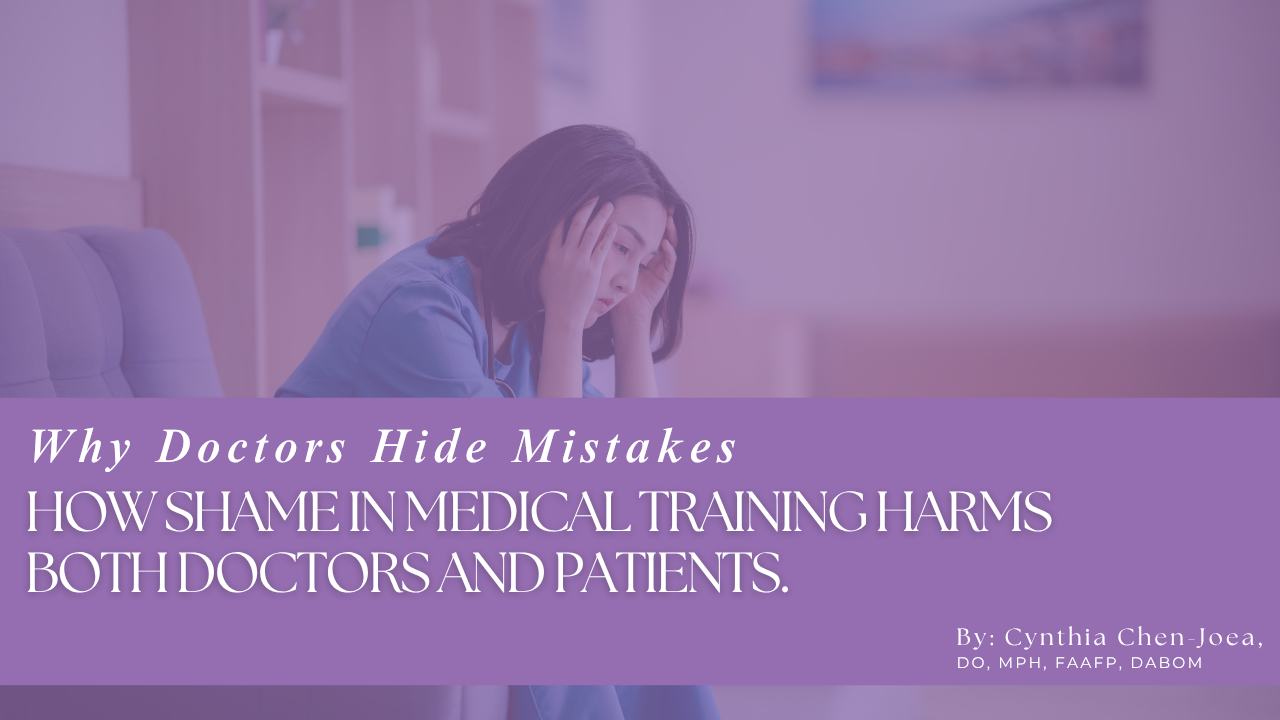
How shame in medical training harms both doctors and patients.
One of my earliest memories of shame in medicine comes from my surgical rotation as a medical student. I woke up at 4 am to be at the hospital by 5 am to round on post-surgical patients. One morning, I forgot to put a patient's identification sticker on the progress note in their paper chart. After my presentation in front of a group of residents and students, the attending called me a "lazy doctor."
My face went hot with shame as I looked down. I had tried so hard, and I didn't know what I could have done better. I thought I had presented well and written a complete progress note. My only mistake was forgetting the sticker.
I never forgot a patient sticker again after that day. I also never forgot the shame of being called a "lazy" doctor.
That's the thing about shame-based teaching: It works in a way. Shame made sure I never forgot again, but it also taught me that making a mistake meant I was a "bad" doctor.
I wasn't alone. Students traded stories all the time, including one about a progress note torn up in front of the group because it was "bad." Fear and shame pushed us to work harder, not because we wanted to be good doctors, but because we didn't want to be bad ones. The takeaway was that good doctors don't make mistakes; only bad doctors do.
This conditioning repeated itself for years, across medical school, hospitals, and rotations. So it's no wonder doctors hide their errors.
Unfortunately, this creates a deeper problem. If a good doctor is someone who never makes mistakes, then admitting one threatens not just your competence but your sense of who you are. A mistake doesn't just make you a bad doctor, it makes you a bad person.
Guilt vs. Shame
It’s important to note the distinction between guilt and shame. Guilt says, "I did something bad, but I'm still a good person." Shame says, "I did something bad because I am bad."
This subtle difference changes behavior. Research by psychologist June Tangney found that guilt tends to motivate people to apologize, make amends, and try to do better. Shame, on the other hand, pushes people to hide, deny, or deflect blame, because a mistake feels like proof that they are a bad person. In medicine, shame and self-judgment after mistakes are linked with increased burnout, depression, and poorer well-being in physicians.
Looking back, I can see that when my attending called me a "lazy doctor," he wasn't correcting a missing sticker. He was judging who I was. That's how shame-based teaching works, and it's why it produces physicians who learn to conceal mistakes rather than confront them.
Is There a Better Way to Handle Medical Mistakes?
Concealment might protect a doctor's ego, but it doesn't protect patients. Doctors are humans, and humans make errors. Sooner or later, every doctor will make a mistake. The real question is what the doctor does afterward.
Because mistakes in medicine can be life-threatening, there is very little room for them. A mistake signals incompetence, and near-misses and errors get swept under the rug. Yet that silence is exactly what keeps errors from being fixed. In her research, Harvard professor Amy Edmondson found that better-functioning teams appeared to report more errors, not fewer. They weren't making more mistakes. They just felt safe enough to talk about them, which is what allowed them to improve.
Increased transparency benefits patients and doctors alike. Many doctors worry that admitting a mistake will lead to a lawsuit or to them being viewed as a “bad” doctor. However, studies have found that patients want to be told when an error has occurred, with an honest explanation and an apology. When the University of Michigan Health System adopted a program of disclosing errors, apologizing, and offering fair compensation, researchers reported that lawsuits and liability costs went down. Similarly, after a Tennessee hospital adopted a communication-and-resolution program, claims filed in court decreased by 42 percent. This shows that patients value honesty and integrity in their physicians, even when something goes wrong.
The good news is that medical education is shifting. Driven in part by feedback from trainees, training programs are shifting away from traditional shame-based teaching and toward environments that foster psychological safety, where learners can say "I don't know" or "I made a mistake" without being humiliated. Faculty development now places greater emphasis on nonviolent communication and feedback that addresses behavior and milestones rather than passing judgment on a person's character. "This chart needs a patient label and here's why it matters for safety" teaches the same lesson as "lazy doctor," without the lasting shame.
Good Doctors Learn From Mistakes
I believe a doctor who can't admit a mistake is more dangerous to you as a patient than a doctor who can.
Of course, everyone wants a knowledgeable doctor who knows what they're doing. But you also want one with the humility to say, "I got that wrong, and here's what I'm changing," and the curiosity to keep learning as medicine evolves.
As a patient, you can look for a doctor who explains their reasoning, welcomes your questions, and is comfortable saying, "I'm not sure. Let me look into that." Rather than signs of incompetence, they’re signs of an honest doctor you can trust.
I still think about that morning on my surgical rotation. The attending taught me to pay attention to details and never forget a sticker. But the shame he used to teach that lesson stayed with me. It took me years to unlearn that my worth as a person depended on my performance as a doctor. Today, I know those two things are separate. A mistake is something I did, not who I am, and certainly not a judgment of my character.
Shame thrives in silence, and it loses its power when we name it. So when I make a mistake now, I try to name it, own it, and learn from it, without letting shame tell me I'm a bad doctor. I try to offer the students and residents I teach that same grace, not because standards don't matter, but because they do. Every time we respond to a mistake with curiosity instead of shame, we help build a culture where doctors can admit errors, learn from them, and keep patients safer. A doctor who isn't ruled by shame is a doctor who's a life-long learner, and that's the doctor every patient deserves.
A version of this was published at Psychology Today: https://www.psychologytoday.com/us/blog/the-other-side-of-the-white-coat/202609/why-doctors-hide-mistakes
References
Edmondson AC. Learning from mistakes is easier said than done: group and organizational influences on the detection and correction of human error. J Appl Behav Sci. 2004;401):5-28. doi:10.1177/0021886396321001
Kim S, Thibodeau R, Jorgensen RS. Shame, guilt, and depressive symptoms: a meta-analytic review. Psychol Bull. 2011 Jan;137(1):68-96. doi: 10.1037/a0021466. PMID: 21219057.
LeCraw FR, Montanera D, Hetzler D, Jackson JP, Keys JC, Mroz TA. Evidence on improvements in medical liability outcomes after the introduction of a communication-and-resolution program at a hospital in Tennessee. J Patient Saf Risk Manag. 2025. doi:10.1177/25160435251319859
Tangney JP, Stuewig J, Mashek DJ. Moral emotions and moral behavior. Annu Rev Psychol. 2007;58:345-372. doi:10.1146/annurev.psych.56.091103.070145

